
Why Data Center Security Matters More Than Ever in Saudi Arabia
Saudi Arabia’s digital economy now runs on infrastructure that did not exist a decade ago, and Data Center Security has become the single most consequential line item in protecting that infrastructure from physical intrusion, cyber compromise, and operational disruption. As Vision 2030 drives unprecedented investment in cloud infrastructure, hyperscale facilities, and sovereign data hosting across Riyadh, Jeddah, and NEOM, the Kingdom’s data centers have become critical national infrastructure in every meaningful sense — housing financial systems, government records, healthcare data, and the digital backbone of the Saudi economy. Expedite IoT delivers the integrated physical and perimeter security technology that Saudi data center operators depend on. Explore our data center perimeter security solutions for Saudi Arabia and understand why protecting these facilities has never carried higher stakes than it does today.
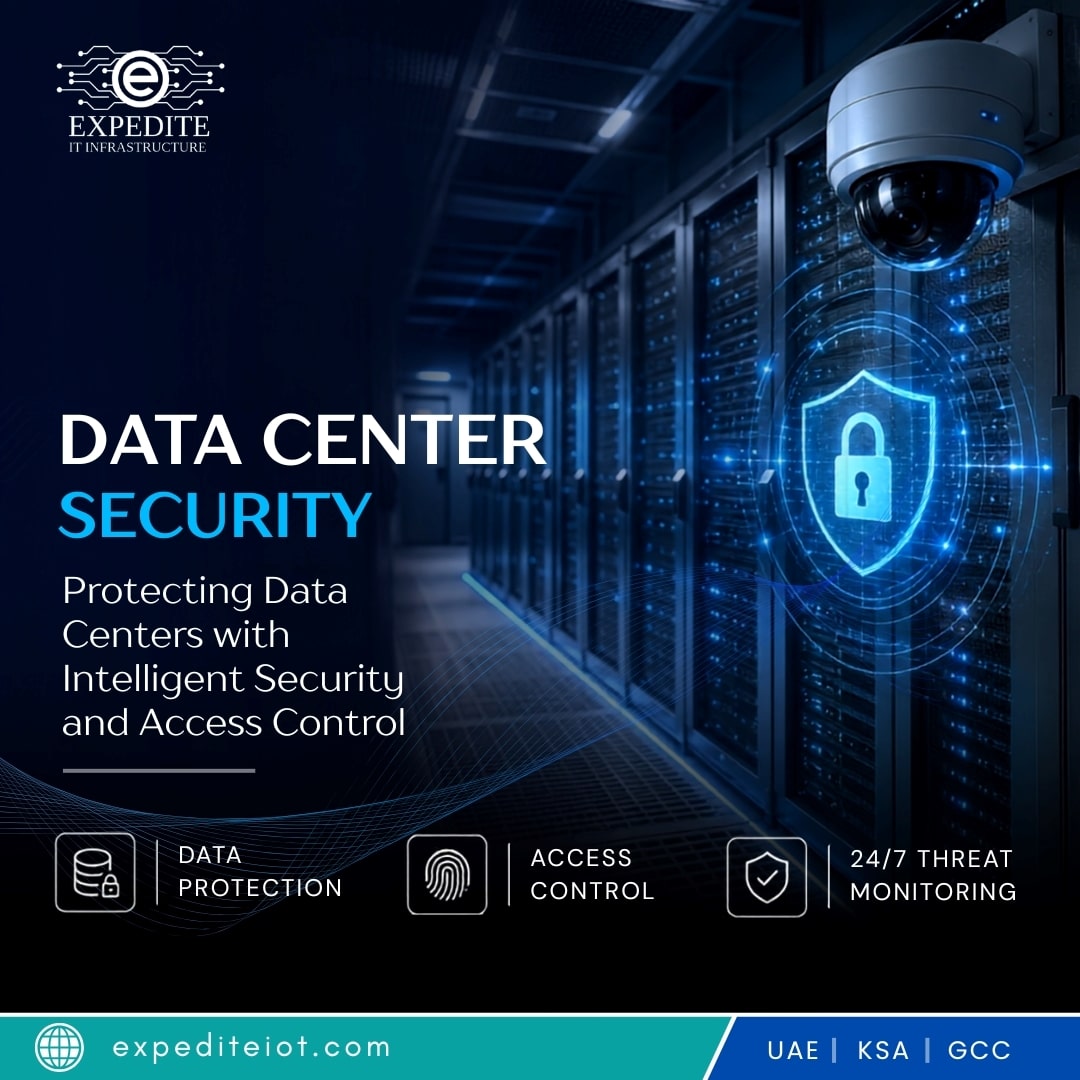
Saudi Arabia’s Data Center Boom and the Security Gap It Has Created
Saudi Arabia’s National Strategy for Data and AI (NSDAI) and the Communications, Space and Technology Commission’s (CST) cloud-first government policy have together catalysed one of the fastest data center growth trajectories in the Middle East, with hyperscale operators, sovereign cloud providers, and telecommunications carriers all expanding capacity across Riyadh’s KAFD technology corridor, Jeddah’s coastal connectivity hubs, and NEOM’s planned digital infrastructure zones. This expansion has occurred at a pace that has, in many cases, outstripped the physical security planning required to protect facilities of this scale and sensitivity, leaving newly commissioned data centers reliant on security architectures designed for far smaller, lower-risk environments.
The stakes attached to this gap are difficult to overstate. A Saudi data center hosting government records, banking transaction systems, or healthcare data represents a single point of failure whose compromise — whether through physical intrusion, insider threat, or a cyber-physical attack exploiting weaknesses in facility access governance — could disrupt services relied upon by millions of citizens and businesses. Regulatory bodies including the National Cybersecurity Authority (NCA) and the Saudi Central Bank (SAMA) have correspondingly raised the compliance bar for facility operators, mandating documented physical security controls as a non-negotiable component of operating licences for any data center handling regulated data categories.
Cybersecurity for Data Center Operations: Why Physical and Digital Security Must Converge
A persistent misconception in facility security planning is treating physical access control and Cybersecurity for Data Center infrastructure as separate disciplines managed by separate teams with separate budgets. In practice, the two are inseparably linked — an attacker who gains unauthorised physical access to a server room can bypass network-layer cybersecurity controls entirely by directly connecting to infrastructure, extracting drives, or installing hardware-based interception devices. Saudi Arabia’s NCA Essential Cybersecurity Controls framework explicitly recognises this convergence, requiring data center operators to demonstrate integrated physical and cyber risk management rather than siloed, independently audited security domains.
Expedite IoT’s approach to Saudi data center protection is built around this convergence principle, designing physical security architecture that directly reinforces the cybersecurity posture of the facility rather than operating as an isolated perimeter layer. Every physical access event, surveillance alert, and intrusion detection trigger is correlated with the facility’s broader security operations centre (SOC) workflow, ensuring that a physical security incident — a forced server room door, an unauthorised badge attempt, a perimeter breach — is treated with the same urgency and investigative rigour as a network intrusion alert.
Core Security Layers Every Saudi Data Center Requires
Data Center Encryption: Protecting Information at Every Layer
While physical security protects the facility itself, comprehensive Data Center Encryption protects the information within it, ensuring that data remains unreadable even in the event that physical or network defences are compromised. Expedite IoT’s security architecture supports facilities implementing encryption at rest using AES-256 standard across storage infrastructure, and encryption in transit using TLS 1.3 protocols for all data moving between systems, racks, and external connections. For Saudi data centers hosting government or financial sector workloads, this encryption posture aligns directly with SAMA Cyber Security Framework requirements and NCA data protection controls, providing a layered defence where even successful physical intrusion does not translate into usable data exposure.
Data Center Firewalls: The Network Perimeter’s First Line of Defence
Robust Data Center Firewalls form the network-layer perimeter that complements physical access control, filtering and monitoring all traffic entering and exiting the facility’s infrastructure. Expedite IoT’s security design incorporates next-generation firewall architecture with deep packet inspection, intrusion prevention capability, and micro-segmentation that isolates critical workloads from broader network zones, limiting the lateral movement available to any attacker who achieves initial network access. For Saudi facilities operating under NCA Essential Cybersecurity Controls, properly configured firewall infrastructure forms a documented, auditable component of the facility’s overall security control framework, with logging and alerting integrated into the broader security operations centre.
Data Center Access Control: Governing Every Door, Rack, and Zone
Granular Data Center Access Control is the physical security foundation upon which every other layer of protection depends. Expedite IoT deploys multi-factor biometric authentication — combining fingerprint, facial recognition, and card credentials — at every facility entry point, server hall door, and individual rack cabinet, ensuring that access is granted exclusively on a verified-need basis rather than broad zone-level permission. Time-based access scheduling restricts entry to approved maintenance windows, anti-passback enforcement prevents credential sharing among technical staff and contractors, and a complete, tamper-evident audit trail of every access event is maintained for regulatory review, satisfying the granular access governance documentation that NCA and SAMA inspections specifically require of regulated data center operators.
Data Center Surveillance: Continuous Visual Verification of Every Zone
Comprehensive Data Center Surveillance provides the visual confirmation layer that access control logs alone cannot deliver. Expedite IoT’s surveillance architecture combines high-resolution fixed and PTZ cameras covering every facility approach, perimeter boundary, server hall aisle, and loading dock, with AI-powered video analytics that automatically detect loitering, unauthorised tailgating attempts, and abandoned objects without requiring constant human monitoring of every feed. Camera footage is automatically associated with corresponding access control events, allowing security investigators to retrieve visual confirmation of any badge swipe, biometric verification, or alarm trigger within a single click, eliminating the manual archive searching that delays incident response and forensic investigation.
Data Center Intrusion Detection: Identifying Breach Attempts in Real Time
Layered Data Center Intrusion Detection technology monitors the facility perimeter and interior zones for unauthorised entry attempts that bypass or defeat standard access control measures. Expedite IoT deploys a combination of perimeter fence-mounted vibration sensors, microwave and infrared beam detection at facility boundaries, door and window contact sensors throughout the building envelope, and motion detection within sensitive interior zones including server halls and network operations centres. Detection events trigger immediate alerts to the on-site security desk and the facility’s security operations centre simultaneously, with integrated camera systems automatically directing PTZ coverage to the triggered zone for instant visual verification of the alarm condition.
Proactive Defence: AI-Driven Threat Detection for Modern Data Centers
Beyond reactive intrusion detection, modern Data Center Threat Detection capability uses behavioural analytics and machine learning to identify anomalous patterns that may indicate an emerging threat before a breach actually occurs. Expedite IoT’s threat detection architecture analyses access patterns, surveillance feeds, and environmental sensor data collectively, flagging anomalies such as an employee badge accessing a zone outside their normal pattern, repeated failed biometric attempts concentrated at unusual hours, or unauthorised vehicles loitering near facility perimeter boundaries. This behavioural baseline approach allows security teams to investigate genuine anomalies proactively, rather than relying exclusively on discrete alarm triggers that only activate once a breach attempt is already underway.
For Saudi data center operators managing multiple facilities across the Kingdom, this threat detection intelligence consolidates into a centralised security operations dashboard, giving corporate security directors a real-time, comparative view of risk indicators across every site. Integration with leading security information and event management (SIEM) platforms ensures that physical security threat intelligence feeds directly into the organisation’s broader cyber-physical risk management programme, supporting the converged security governance model that NCA and SAMA regulatory frameworks increasingly expect from critical infrastructure operators.
Data Center Security KSA: Compliance-Ready Architecture for the Kingdom
Deploying effective Data Center Security KSA infrastructure requires a security architecture built specifically around the Kingdom’s regulatory framework rather than a generic international template applied without localisation. Expedite IoT’s deployment methodology incorporates compliance documentation pre-formatted for NCA Essential Cybersecurity Controls audits, SAMA Cyber Security Framework requirements for financial sector facilities, and the Communications, Space and Technology Commission’s (CST) data center licensing standards. For facilities hosting government or sovereign cloud workloads, the architecture additionally aligns with Saudi data residency requirements administered by the Saudi Data and Artificial Intelligence Authority (SDAIA), ensuring that physical security documentation satisfies every layer of regulatory review a Saudi data center operator may face.
Expedite IoT’s Saudi-based engineering and security design team manages the complete deployment lifecycle — from initial threat and vulnerability assessment through perimeter security design, access control architecture, surveillance system specification, intrusion detection deployment, and security operations centre integration — with formal project delivery timelines established at contract signature and aligned to the facility’s broader construction or commissioning programme. Our Saudi Arabia data center security design and deployment team works directly with facility architects, MEP consultants, and IT infrastructure teams to ensure physical security is engineered into the building from the earliest design stage rather than retrofitted after construction is complete.
Conclusion
Saudi Arabia’s digital future depends on data centers that are protected at every layer, and comprehensive Data Center Security is no longer optional infrastructure — it is foundational.
Expedite IoT unites Cybersecurity for Data Center resilience with robust Data Center Encryption and intelligent Data Center Firewalls to defend every byte of data.
Granular Data Center Access Control, continuous Data Center Surveillance, and layered Data Center Intrusion Detection defend every physical entry point.
Proactive Data Center Threat Detection and fully compliant Data Center Security KSA architecture keep Saudi facilities ahead of emerging risk.
FAQs
FAQ 1: What does comprehensive Data Center Security in Saudi Arabia actually include?
Comprehensive Data Center Security combines multiple integrated layers: biometric access control governing every door and rack, continuous video surveillance with AI-powered analytics, perimeter intrusion detection using vibration and infrared sensing, encryption protecting data at rest and in transit, next-generation firewall infrastructure securing network traffic, and behavioural threat detection that identifies anomalies before a breach occurs. Saudi regulatory frameworks including NCA Essential Cybersecurity Controls and SAMA’s Cyber Security Framework require this converged physical and digital approach rather than treating any single layer as sufficient protection on its own.
FAQ 2: How does Data Center Access Control prevent insider threats from authorised personnel?
Expedite IoT’s Data Center Access Control architecture limits insider threat exposure through granular, need-based zone permissions rather than broad facility-wide access, time-based scheduling that restricts entry to approved maintenance windows, anti-passback enforcement that prevents credential sharing, and a complete tamper-evident audit trail of every access event including individual rack-level entries. Multi-factor biometric authentication ensures that even an employee with legitimate broader access cannot deny having accessed a specific zone, creating accountability that significantly reduces the opportunity and likelihood of insider-facilitated security incidents.
FAQ 3: Why is Data Center Surveillance combined with intrusion detection rather than deployed alone?
Comprehensive Data Center Surveillance provides visual confirmation, while Data Center Intrusion Detection identifies the moment a breach attempt occurs through sensors that surveillance cameras alone cannot replicate, such as perimeter fence vibration or infrared beam interruption. When combined, an intrusion detection trigger automatically directs PTZ camera coverage to the affected zone for instant visual verification, allowing security teams to confirm whether an alert represents a genuine threat or a false positive within seconds, rather than relying on either technology in isolation, which leaves either a detection gap or a verification gap in the facility’s defensive posture.
FAQ 4: How does Data Center Threat Detection identify risks before a physical breach occurs?
Expedite IoT’s Data Center Threat Detection capability applies behavioural analytics across access patterns, surveillance feeds, and environmental sensor data to identify anomalies that precede an actual breach attempt, such as repeated failed biometric verifications concentrated at unusual hours, badge access patterns deviating from an individual’s established baseline, or unauthorised vehicles loitering near perimeter boundaries. This proactive approach allows security teams to investigate and intervene before a genuine intrusion attempt is made, rather than relying exclusively on reactive alarm triggers that only activate once a breach is already in progress.
FAQ 5: What compliance standards does Data Center Security KSA architecture need to satisfy?
A compliant Data Center Security KSA deployment must satisfy the National Cybersecurity Authority’s (NCA) Essential Cybersecurity Controls, the Saudi Central Bank’s (SAMA) Cyber Security Framework for financial sector facilities, the Communications, Space and Technology Commission’s (CST) data center licensing standards, and Saudi Data and Artificial Intelligence Authority (SDAIA) data residency requirements for facilities hosting government or sovereign cloud workloads. Expedite IoT’s deployment methodology incorporates pre-formatted compliance documentation aligned to each of these frameworks, ensuring that facility operators can demonstrate audit-ready physical security governance during regulatory inspections without compiling evidence manually after the fact.
For more information contact us on:
Expedite IT
+966 502104086
Office No 01, Conference Building (Kirnaf Finance), Abi Tahir Al Dhahabi Street,
Al Mutamarat, Riyadh 12711, Saudi Arabia
Or click on the below link for more information:
https://www.expediteiot.com/data-center-perimeter-security-in-saudi-arabia/

