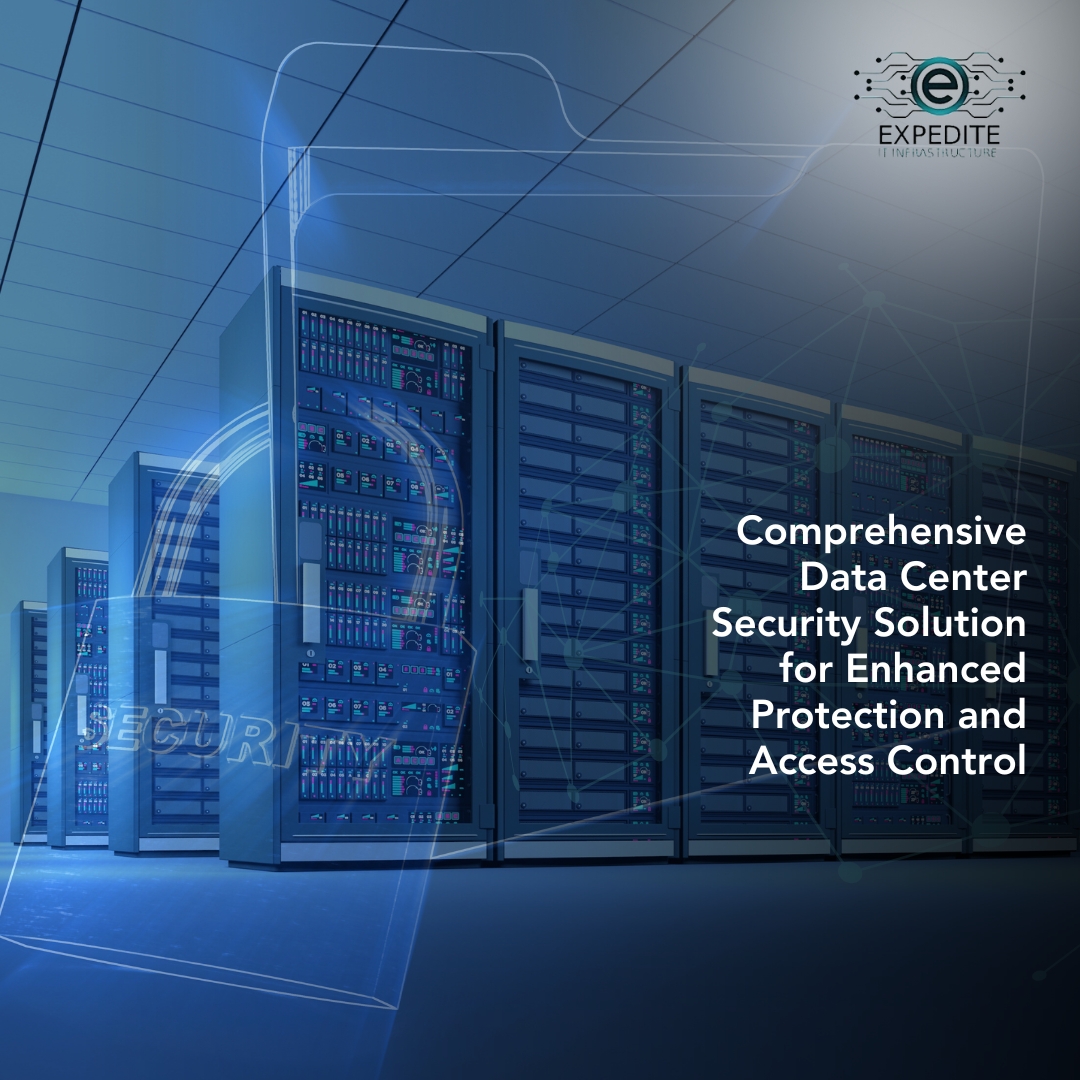
Protecting Digital Assets with Data Center Security in Saudi Arabia
Robust Data Center Security is the most critical investment any organisation can make to protect its digital future in Saudi Arabia. As the Kingdom’s Vision 2030 agenda drives an unprecedented surge in cloud adoption, hyperscale infrastructure construction, and national digitalisation programmes, the volume and value of data being processed and stored within Saudi borders has grown exponentially. State-sponsored cyber actors, ransomware syndicates, and insider threats have simultaneously grown more sophisticated — making the protection of data centre infrastructure a board-level strategic priority, not merely a technology consideration. This authoritative guide examines every layer of data centre protection that modern Saudi organisations must deploy, and explains why Expedite IoT is the Kingdom’s trusted partner for end-to-end digital asset defence.
The Stakes: Why Saudi Arabia’s Data Centers Are High-Value Targets
Saudi Arabia now hosts some of the most strategically significant data infrastructure in the Middle East. Hyperscale facilities operated by global cloud providers, national data repositories maintained by government ministries, financial transaction processing centres for Saudi Arabia’s banking sector, and operational technology data hubs for Aramco and SABIC’s industrial networks collectively represent an immense concentration of national and commercial value within a relatively small physical and digital footprint.
According to the Saudi National Cybersecurity Authority (NCA), the Kingdom recorded a significant increase in targeted cyberattacks on critical infrastructure over the past three years, with data centres among the most frequently targeted assets. The consequences of a successful breach extend far beyond immediate financial loss — regulatory penalties under Saudi Arabia’s Personal Data Protection Law (PDPL), reputational destruction, operational disruption to downstream services, and, in the case of critical national infrastructure, potential national security implications.
Five converging factors make comprehensive data centre protection non-negotiable for Saudi organisations today:
- Regulatory obligation: NCA’s Essential Cybersecurity Controls (ECC) and Critical Systems Protection (CSP) standards mandate specific technical and procedural security controls for data centre operators
- PDPL compliance: Saudi Arabia’s Personal Data Protection Law requires data controllers to implement appropriate technical safeguards — inadequate data centre security constitutes a direct compliance breach
- Cloud sovereignty requirements: Government entities and regulated industries must ensure data processed within KSA remains under Saudi jurisdiction with verifiable security controls
- Supply chain complexity: Modern data centres integrate hardware and software from dozens of global vendors, each representing a potential compromise vector requiring active monitoring
- Insider threat elevation: The rapid workforce expansion associated with Vision 2030 mega-projects increases the statistical likelihood of both malicious and negligent insider incidents
The Seven Layers of Data Center Protection: A Complete Technical Framework
Expedite IoT engineer’s data centre protection as a seven-layer architecture — from the physical perimeter to the individual workload — ensuring that no single point of failure can compromise the entire facility. Each layer is described below with its specific relevance to the Saudi regulatory and threat environment.
Layer 1: Cybersecurity for Data Center — Building the Foundational Security Posture
Cybersecurity for Data Center encompasses the governance framework, policies, procedures, and technology controls that collectively define an organisation’s security posture. Expedite IoT begins every engagement with a comprehensive risk assessment aligned to the NCA ECC framework, identifying control gaps and prioritising remediation based on threat likelihood and business impact. This foundational layer includes security operations centre (SOC) integration, security information and event management (SIEM) deployment, vulnerability management programmes, and regular penetration testing — creating a continuously improving security posture rather than a static point-in-time compliance exercise.
Layer 2: Data Center Threat Detection — Identifying Attacks Before They Succeed
Data Center Threat Detection is the active intelligence function that distinguishes a reactive security programme from a proactive one. Expedite IoT deploys AI-powered intrusion detection systems (IDS), network traffic analysis (NTA) platforms, and user and entity behaviour analytics (UEBA) tools that establish baselines of normal activity and generate high-fidelity alerts when deviations occur. In the context of the Kingdom’s threat landscape — which includes advanced persistent threat (APT) groups with nation-state resources — the ability to detect lateral movement, command-and-control communications, and data exfiltration attempts within minutes rather than months is operationally decisive.
Threat detection capabilities deployed by Expedite IoT in KSA facilities include:
- East-west traffic inspection between internal network segments using next-generation IDS sensors
- Deception technology (honeypots and honeynets) that attract and expose threat actors operating within the perimeter
- File integrity monitoring (FIM) on critical system files and configuration databases
- DNS traffic analysis to identify command-and-control beacon activity
- Privileged account monitoring with real-time anomaly alerting for administrative credential misuse
Layer 3: Data Center Firewalls — Segmenting and Hardening the Network Perimeter
Data Center Firewalls form the enforcement layer of network security architecture, controlling traffic flows between network segments and preventing unauthorised communication. Expedite IoT designs and deploys next-generation firewall (NGFW) architectures incorporating application-layer inspection, SSL/TLS decryption, geo-blocking of high-risk source countries, and micro-segmentation — ensuring that a compromise in one network zone cannot propagate laterally to adjacent systems. For KSA government and regulated-industry clients, firewall rulesets are documented, version-controlled, and audited quarterly in alignment with NCA ECC Control Domain 3 requirements.
Layer 4: Data Center Encryption — Protecting Data at Rest, in Transit, and in Use
Data Center Encryption ensures that even if an attacker successfully exfiltrates data — bypassing every other control — the stolen information remains cryptographically unintelligible and operationally useless. Expedite IoT implements AES-256 encryption for data at rest across all storage tiers, TLS 1.3 for all data-in-transit across internal and external networks, and hardware security modules (HSMs) for cryptographic key management — ensuring that encryption keys are never stored alongside the data they protect. For Saudi government and financial sector clients, key management architectures are designed to maintain data sovereignty, with HSMs physically located within KSA borders.
Layer 5: Server Room Security — Controlling Physical Access to the Compute Layer
Server Room Security addresses the often-underestimated physical attack surface of data infrastructure. A sophisticated cyber adversary who gains physical access to a server room can defeat almost any logical security control in minutes — extracting storage media, installing hardware keyloggers, or disrupting cooling systems to induce thermal damage. Expedite IoT implements multi-factor physical access control at all server room entry points, continuous video surveillance with AI-based behavioural analytics, man-trap (airlock) entry vestibules for high-security facilities, environmental sensors for temperature, humidity, water leakage, and vibration, and comprehensive visitor and contractor management integration — ensuring that the physical security of compute infrastructure matches its logical protection.
Layer 6: Rack-level Security — Granular Protection at the Asset Level
Rack-level Security represents the most granular layer of physical data centre protection, controlling access to individual equipment racks within the server room itself. Expedite IoT deploys electronic rack locks with individual credential requirements, audit-logged opening events, and remote management capability — ensuring that a technician authorised to access the server room cannot access racks outside their assigned scope without generating an alert. For colocation facilities in Riyadh and Jeddah where multiple tenants share physical floor space, rack-level security is the primary mechanism ensuring tenant isolation and preventing cross-contamination of physical access rights.
Data Center Security KSA: The National Regulatory and Standards Landscape
Operating a compliant and secure data centre in Saudi Arabia requires navigating a multi-layered regulatory environment that is both comprehensive and actively evolving. Organisations deploying Data Center Security KSA-wide must align with the following key frameworks:
- NCA Essential Cybersecurity Controls (ECC-1:2018): The foundational national cybersecurity standard applicable to all government entities and critical national infrastructure operators, covering 114 security controls across five domains
- NCA Critical Systems Protection (CSP-1:2019): Enhanced requirements for operators of systems classified as critical national infrastructure, including specific data centre physical and logical security mandates
- PDPL (Federal Decree-Law 2021): Personal data protection obligations requiring technical safeguards commensurate with data sensitivity — directly impacting data centre architecture and access governance
- SAMA Cybersecurity Framework: Saudi Central Bank’s cybersecurity requirements for financial sector entities, including specific data centre resilience and security control mandates
- CITC Regulations: Communications and Information Technology Commission requirements for telecommunications and cloud service providers operating data centre infrastructure in the Kingdom
- Uptime Institute Tier Standards: Internationally recognised infrastructure availability and security design benchmarks increasingly referenced in Saudi government procurement specifications
City-Specific Deployment Landscape Across Saudi Arabia
Data Center Security Riyadh
As the Kingdom’s capital and the nexus of its government, financial, and commercial digital infrastructure, Data Center Security Riyadh encompasses the most complex and highest-stakes deployments in the country. The concentration of government ministry data centres in the King Abdulaziz City for Science and Technology (KACST) zone, financial sector facilities along King Fahd Road, Aramco’s digital operations hubs, and the hyperscale data centres emerging within NEOM’s digital backbone creates a threat environment that demands the most sophisticated multi-layer security architectures. Expedite IoT maintains a dedicated Riyadh NOC and engineering team to provide 24/7 monitoring, rapid incident response, and continuous compliance management for capital-region clients.
Data Center Security Jeddah
Data Center Security Jeddah is shaped by the city’s dual role as Saudi Arabia’s primary Red Sea port gateway and its most internationally connected commercial hub. Jeddah’s data centres support the Kingdom’s largest e-commerce operations, the financial infrastructure of its busiest port, regional headquarters of multinational corporations, and the digital backbone of the Red Sea Global tourism mega-project. The city’s strategic position as a submarine cable landing point makes its data infrastructure a high-priority target for sophisticated threat actors, driving demand for advanced perimeter security, real-time threat intelligence integration, and redundant physical protection systems. Expedite IoT’s Jeddah-based team delivers sector-specific expertise across all these environments.
Industry-Specific Data Center Security Applications in KSA
Financial Services and Banking
Saudi banks and financial institutions regulated by SAMA operate some of the most security-sensitive data environments in the Kingdom. Expedite IoT deploys SAMA Cybersecurity Framework-aligned architectures featuring network micro-segmentation, real-time transaction monitoring integration, HSM-based key management, and quarterly penetration testing — ensuring both regulatory compliance and operational resilience against financially motivated threat actors.
Government and Critical National Infrastructure
For ministries, regulatory bodies, and Vision 2030 programme offices, Expedite IoT designs sovereign data centre security architectures with air-gapped networks for the most sensitive workloads, NCA ECC-compliant control frameworks, and Arabic-language security operations capability — ensuring that Saudi government data assets are protected to the highest national standards.
Energy, Oil, and Gas
The operational technology (OT) environments within Aramco, SABIC, and their contractor ecosystems present unique security challenges at the intersection of IT and industrial control systems. Expedite IoT’s OT-aware security architecture enforces strict IT-OT network segmentation, deploys industrial protocol-aware intrusion detection, and implements physical security controls calibrated for the safety-critical nature of energy infrastructure.
Healthcare and Life Sciences
Saudi hospitals and pharmaceutical manufacturers processing patient health records and clinical research data require CBAHI-aligned data centre security that specifically addresses HIPAA-equivalent privacy obligations for health data, medical device network isolation, and chain-of-custody controls for regulated research data — all delivered within Expedite IoT’s comprehensive protection framework.
Telecommunications and Cloud Service Providers
CITC-regulated telecommunications operators and cloud service providers hosting multi-tenant workloads require data centre security architectures that enforce tenant isolation at every layer — from physical rack access through logical network segmentation to cryptographic key separation — while maintaining the operational efficiency needed to deliver competitive service levels.
The Broader Data Center Security
Understanding the full lexicon of data centre protection enables procurement teams to evaluate vendors comprehensively and ask the right questions:
- Zero trust architecture – Security model requiring continuous verification of every user, device, and workload regardless of network location
- Network micro-segmentation – Division of data centre networks into fine-grained zones with individual access policies to limit lateral threat movement
- Security operations centre (SOC) – Dedicated team and technology platform providing 24/7 monitoring, detection, and response for security events
- Privileged access management (PAM) – Controls governing administrative and privileged account usage — the most frequently targeted credential class in data centre attacks
- Hardware security module (HSM) – Tamper-resistant physical device managing cryptographic key generation, storage, and operations
- Colocation security – Physical and logical security controls specific to shared data centre environments where multiple tenants occupy the same facility
- Business continuity and disaster recovery (BCDR) – Security-integrated resilience planning ensuring data centre operations survive and recover from both cyber and physical incidents
- Penetration testing – Authorised simulated attacks against data centre infrastructure to identify exploitable vulnerabilities before adversaries do
- SIEM and SOAR platforms – Security information and event management combined with security orchestration, automation, and response — the technical backbone of modern SOC operations
Why Expedite IoT Is Saudi Arabia’s Most Trusted Data Center Security Partner
Expedite IoT has established an unmatched reputation in the Kingdom’s data centre security market through a combination of deep technical expertise, genuine local operational capability, and a consistent record of delivering measurable security outcomes for the Kingdom’s most demanding clients. The E-E-A-T credentials that define Expedite IoT’s market leadership are:
- Experience: Proven multi-sector deployments across government ministries, financial institutions, energy sector operators, healthcare providers, and telecommunications companies in Riyadh, Jeddah, Dammam, and emerging giga-project sites
- Expertise: Certified security engineers holding CISSP, CISM, CEH, and ISO 27001 Lead Auditor credentials; dedicated NCA compliance team tracking ECC, CSP, and PDPL regulatory developments; OT security specialists for industrial data centre environments
- Authoritativeness: NCA-approved vendor status for critical national infrastructure projects; cited in regional cybersecurity industry publications; active participant in Saudi cybersecurity standards development forums
- Trustworthiness: ISO 27001-certified information security management system; transparent SLAs with 99.9% SOC uptime guarantee; 24/7 bilingual Arabic/English incident response hotline; published client reference programme with verified case studies
Expedite IoT’s commercial flexibility — spanning outright CAPEX purchase, managed security service provider (MSSP) subscription, and hybrid models — ensures that organisations of every size and budget profile can access enterprise-grade data centre protection without compromise.
Conclusion
Saudi Arabia’s digital transformation is creating data infrastructure of extraordinary national and commercial value — and an equally extraordinary threat landscape determined to exploit it. Protecting that infrastructure demands a security approach that is layered, intelligent, continuously monitored, and aligned to the Kingdom’s evolving regulatory requirements.
From the governance foundation of Cybersecurity for Data Center frameworks through the active intelligence of Data Center Threat Detection, the network enforcement of Data Center Firewalls, and the cryptographic assurance of Data Center Encryption — to the physical disciplines of Server Room Security and granular Rack-level Security — every layer of protection Expedite IoT deploys is purpose-engineered for the Saudi threat environment and regulatory context.
With city-leading expertise across Data Center Security Riyadh and Data Center Security Jeddah, the Kingdom’s most comprehensive Data Center Security KSA-wide regulatory alignment, and the regional market’s deepest bench of certified security engineers, Expedite IoT stands as the partner Saudi organisations trust to protect their most critical digital assets — today, and as the Kingdom’s digital ambitions continue to grow.
FAQs
FAQ 1: What regulatory standards must Data Center Security in KSA comply with?
Data centre operators and tenants in Saudi Arabia must align with several overlapping regulatory frameworks. The NCA’s Essential Cybersecurity Controls (ECC) apply to all government entities and critical infrastructure operators, while the NCA Critical Systems Protection (CSP) standard imposes enhanced requirements on the most sensitive facilities. Saudi Arabia’s PDPL mandates technical safeguards for all personal data processing environments. Financial sector data centres must additionally comply with the SAMA Cybersecurity Framework, and telecommunications operators fall under CITC regulations. Expedite IoT’s Data Center Security KSA deployments are designed with all applicable frameworks embedded from the architecture stage, ensuring structural compliance rather than retroactive adaptation.
FAQ 2: How does Data Center Threat Detection differ from traditional antivirus or firewall protection?
Traditional antivirus and firewall solutions rely primarily on known-bad signatures and static rule sets — approaches that sophisticated threat actors routinely evade using novel malware variants and legitimate administrative tools. Data Center Threat Detection platforms deployed by Expedite IoT use AI-driven behavioural analysis, network traffic anomaly detection, and user and entity behaviour analytics (UEBA) to identify threats based on what they do rather than what they look like — detecting advanced persistent threats, insider attacks, and zero-day exploits that signature-based tools entirely miss. This approach is specifically calibrated for the nation-state and organised cybercrime threat actors targeting Saudi critical infrastructure.
FAQ 3: Why is Rack-level Security necessary if the server room already has access control?
Server room access control manages who can enter the physical facility, but does not govern which specific equipment individuals can physically access once inside. In colocation environments, a technician from one tenant organisation could theoretically interact with another tenant’s hardware if only perimeter-level controls are in place. Rack-level Security through individually credentialed electronic locks ensures that each rack is accessible only to specifically authorised individuals, with every access event timestamped and logged. This granular control is also essential for compliance evidence in NCA audits and for forensic investigation following any physical security incident.
FAQ 4: How does Data Center Encryption protect data if an attacker gains physical access to storage media?
Data Center Encryption using AES-256 for data at rest means that storage media — hard drives, SSDs, tape — removed from a facility without authorisation contains only cryptographically scrambled data that is computationally infeasible to decode without the correct encryption keys. Expedite IoT implements hardware security module (HSM)-based key management ensuring those keys are never stored alongside the encrypted data they protect and are physically secured within Saudi borders for sovereign data environments. This renders physical media theft, which has historically been a significant attack vector against data centres, operationally futile for the attacker.
FAQ 5: What is the typical timeline for deploying a comprehensive Data Center Security programme in Riyadh or Jeddah?
Timeline depends on scope and existing security maturity. Expedite IoT’s standard engagement begins with a two-to-three-week risk assessment and gap analysis, followed by a phased implementation roadmap. Priority controls — including Data Center Firewalls, SOC integration, and physical access controls — are typically operational within 30-60 days. Full multi-layer architecture deployment, including advanced threat detection, encryption key management infrastructure, and Server Room Security upgrades, is generally completed within 90-120 days for a single facility. Enterprise-wide programmes covering Data Center Security Riyadh and Data Center Security Jeddah sites simultaneously are managed under a dedicated programme governance structure with phased milestones, executive reporting, and formal NCA-aligned commissioning documentation.
For more information contact us on:
Expedite IT
+966 502104086
Office No 01, Conference Building (Kirnaf Finance), Abi Tahir Al Dhahabi Street,
Al Mutamarat, Riyadh 12711, Saudi Arabia
Or click on the below link for more information:
https://www.expediteiot.com/data-center-perimeter-security-in-saudi-arabia/